
Prototyping the Shogi Piece Polyhedron | From Artwork to a Repeatable Production Specification
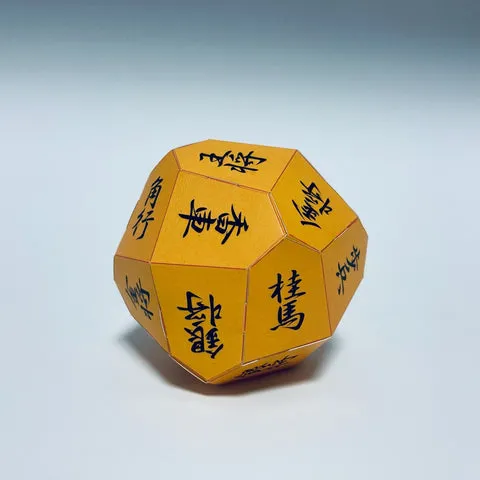
After seeing requests for tdk1986's Shogi Piece Polyhedron to be sold at the Shogi Hall, I contacted the original designer and began considering a specification suitable for production in quantity.
What a repeatable production specification required
What if we made 1,000 units, or 3,000 or more? I considered what would be needed to turn a one-off craft object into a product that could reach more people with a consistent finish.
tdk1986's original pattern was connected as a single piece. Preserving what made it work while considering production meant reviewing several conditions together:
- How to lay out the parts on a sheet without reducing their size
- Whether to use a cutting die or laser cutting
- Mailing costs and ease of handling during delivery and storage
- The risk of damage or mistakes during assembly
- Ease of handling the parts during assembly
An interesting form alone does not make a production specification. Processing, transport, storage, and assembly all have to connect.
Six identical pieces assembled like a puzzle
The resulting prototype arranged six identical pieces that join like a puzzle. A printing company helped us produce it in a special synthetic paper.
I felt comfortable handling this synthetic paper during assembly, with less concern about tearing or delamination. The snapping sensation was enjoyable, too. The design can also be made from ordinary paperboard.
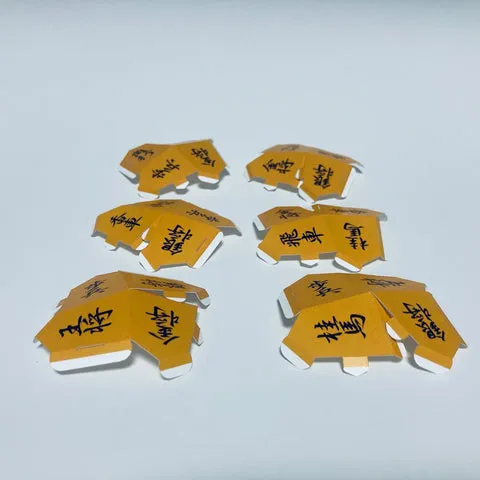
The form can be completed from different starting points, but marking the insertion positions would help people follow the sequence in the original design. Small instructions like these are part of reducing confusion and damage during assembly.
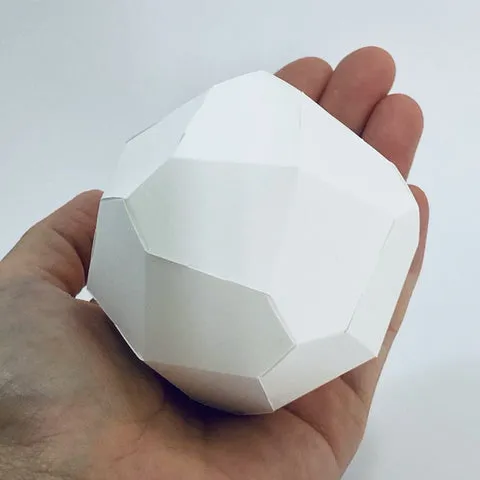
Still the first white sample
At the time of this article, this was the first white sample used to check the form.
The next stage was to consider graphics that made meaningful use of printing, an assembly diagram, and packaging. Selling it at the Shogi Hall was still an idea at this point.
The prototype retained the hand-held size of the original pattern.
Our papercraft service and ordering guide are available in Japanese only. For questions in English about quantities, materials, or an early-stage structure, use the paper packaging contact form.
Contact Us
We are happy to discuss package design, papercraft, and other paper-based products.
Contact Us